
Let’s say you get up at dawn on May 21. The Sun is rising. It’s in the first degree of Gemini, so that means that Gemini is rising too. Around noon, the Sun is as high in the sky as it can be – and therefore so is Gemini, right on the Midheaven along with the Sun. Sunset? Gemini is on the Descendant.
No surprises in any of that. It’s just Earth turning on its axis. In the course of twenty-four hours, each sign rises once.
Switching gears, how do we define progressions? Again, this is very elementary astrology. Days become years. If you want to know where your progressed Venus is located on your fortieth birthday, count forty days after you were born. Where was Venus then? That’s its progressed position.
In a single day, each sign rises once. Following the strict logic of progressions, one day turns into one year – and therefore in the course of one single year, each sign should rise once by progression. In other words, you should have a brand new progressed Ascendant every month or so.
Technically, this very pure method of progressing the Angles is called Daily Houses. In my experience, nobody uses it very much. In terms of actual impact, this form of progressing the Angles works very much like the equally fast transits of the Sun, Mercury, and Venus. Like them, it triggers events, but it doesn’t reveal big developmental patterns. Daily Houses are miles away from true “First Net” material.
The key point for our purposes here is that the Daily Houses method is actually the only logically consistent application of progressions theory to the four Angles of the chart – days become years, period. It’s totally straightforward. Meanwhile, all of the other methods of progressing the Angles have to dance around a variety of rationalizations.
Before we get into the weeds with all of this – you can call me Mister Capricorn, but let me just say that I’m not comfortable with rationalizations or lapses in logic. I do get my own joke – I believe that the universe is a lot more comfy with those kinds of things than I am! But still, here’s what works for me: when it comes to progressed Angles, I use straight solar arcs. However far your Sun has progressed since the day you were born, I add that same number of degrees to everything else, including the Ascendant, Descendant, Midheaven, and the astrological nadir. That’s all straightforward solar arc theory, so, unlike with the other forms of progression for the Angles, no complications are swept under the carpet.
Technically, by the way, that 4th house cusp is called the Imum Coeli, which is Latin for “bottom of the sky.” Its most common pronunciation is IMM-um CHAY-lee. Often in practice, astrologers simply refer to it as the “IC.”
WHAT ACTUALLY WORKS?
I do have to say that I’ve often gotten pretty good results with other methods for progressing the Angles, but in the interest of not overwhelming myself by trying to use too many versions of astrology all at once, in practice I limit myself to solar arcs. That’s a personal choice, and I wouldn’t discourage anyone from working with other methods – just make sure that you don’t suffocate your intuition by trying to juggle too many balls at once.
Just quickly, here are three of my own personal experiences with solar arc Angles. They really do work! Often they are uncannily accurate in terms of the timing of events.
My Midheaven squared my natal Uranus just a few months before I graduated from college. I decided to focus on astrology rather than going to graduate school – a choice which everyone around me viewed as “Uranian,” to put it politely.
By solar arc, my Ascendant formed a conjunction with my natal Venus within one month of starting my full-time astrological counseling practice – I emphasize “counseling” for the obvious Venus connection.
By solar arc, the Midheaven squared my Jupiter the very month that my first book was published – nicely precise in timing, and also illustrating the idea that squares are not always bad news.
ONWARD INTO THE WEEDS
I’ve always felt that there’s something good to be said for astrologers understanding the astronomical basis of our craft. I do believe in that principle, but in all honesty if I were pressed to defend it, I’m not sure that I would be very convincing. Certainly there are many fine astrological counselors who can’t tell a Vertex from the Celestial Equator. One happy bottom line: there are no “points off” for any of you in the FCEA community who skip the rest of this edition of Master’s Musings! None of it is particularly relevant when you’re sitting with charts and people with tears in their eyes.
Matrix’s Winstar software – which is the program I’ve used for most of my career – has a method of progressing the Angles which they call Secondary MC. Years ago, I asked co-founder Stephen Erlewine how these Matrix calculations were made. Here’s what he told me.
“The first attempt was to duplicate what most astrologers were doing by hand at that time, and we call it Secondary MC. The Sun’s position is calculated for the progressed date using one-day-equals 365.25 days, then the solar arc is calculated from that position and that arc is added to the natal MC and the houses derived. But instead of using the arc along the ecliptic as in the solar arc method, it is added along the celestial equator since that more closely approximates the Midheaven that our customers were used to using, and, of course, the Right Ascension of the Midheaven is the basis of any house system.”
Confused? See below for some definitions. This diagram might help you visualize everything we’re about to explore.
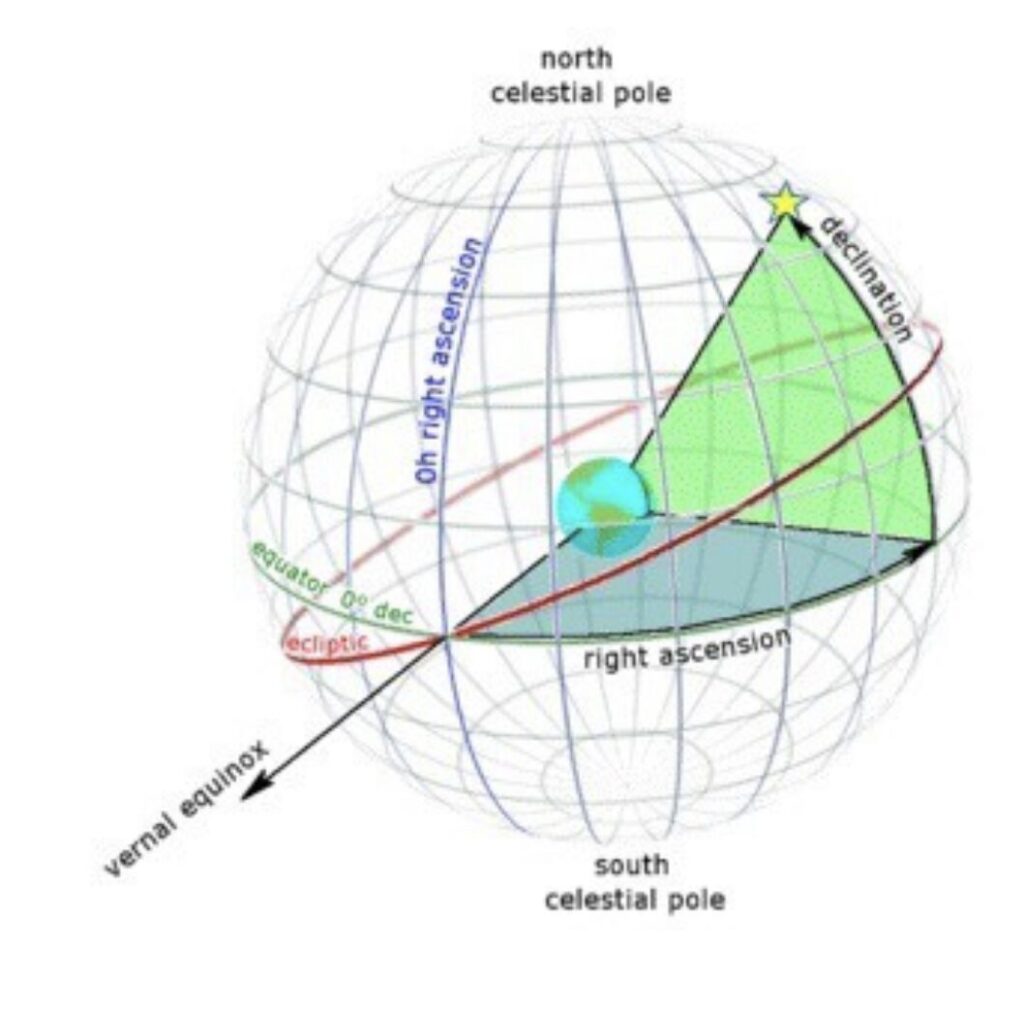
Astrology, as we practice it in the FCEA, is based on the familiar twelve signs, which are defined by the Equinoxes and the Solstices. That’s the zodiac – although astronomers call it the ecliptic. It is simply the apparent yearly path of the Sun as it travels against the starry background. The ecliptic is one “line in the sky.” There’s another: we can also project Earth’s equator out onto space – and, no surprise, that line is called the celestial equator.
The plane of the ecliptic is tilted about twenty-three and a half degrees relative to the plane of the equator, as you can see in the diagram.
Declination is a measurement based on the celestial equator. It corresponds to what we call latitude on Earth – that is to say it represents a planet’s elevation north or south of the equator. Mincing the words a bit, you might say that Norway has a “higher declination” than Spain.
Meanwhile, right ascension (to which Stephen Erlewine referred) corresponds to earthly longitude, which is to say that it is based on the celestial equator. Arbitrarily, we start counting longitude on Earth from the Greenwich meridian near London. Similarly, the 0° longitude point of right ascension is the position of the Vernal Equinox on the celestial equator.
Ready for more weeds? Right from the start of this essay, the issue we’re exploring is that all of the methods for progressing the Angles depend on some rationalization and improvisation. As we saw, the only method that is absolutely consistent logically is the “Daily Houses” approach, with each month bringing you a new progressed Ascendant and Midheaven. A little while ago, I confessed that in my own practice I simply apply the standard solar arc approach to the Angles. In the other methods, some astrological theorists – most of whom are far better astronomers than myself – have actually had a similar instinct about using solar arcs, but they’ve applied them in more technical ways. Still, it’s a helpful perspective to remember that they all use some variation on solar arcs.
Before we go any further, let’s add one more necessary complication. We speak of the Sun’s progressed speed – and thus the speed of all solar arcs – as “one degree per year.” That figure is actually an approximation. Earth’s orbit around the Sun is elliptical, so we speed up and slow down in the course of a year. Earth is closest to the Sun – and thus moving at its fastest speed – every year around January 3rd. In practical terms, that means that if you were born during the colder months in the northern hemisphere, your progressed Sun – and thus your solar arcs – are moving a little faster than one degree per year. It’s vice versa if you were born during the warm months.
The average annual speed of the progressed Sun is 59’ 08” – that’s actually just under one degree per year. But it varies about 1.6% from that figure over the course of twelve months.
Is your head spinning? I’d be the first to confess mine is spinning too. Like most of you in the FCEA, I’m a counselor, not an astronomer.
With this next step, I’m definitely edging into “over my head” territory . . .
The Midheaven – and thus the other three Angles – can be progressed by solar arc either along the ecliptic (that is, in celestial longitude) or along the celestial equator (that is, in right ascension).
Furthermore, it can be progressed by the actual measured solar arc – that is, taking into account the Sun’s annual variation in speed. Alternatively, it can be progressed in a constant fashion, using that average figure of 59’08” per year. That method is called Naibod, by the way.